
Provence’s Santons
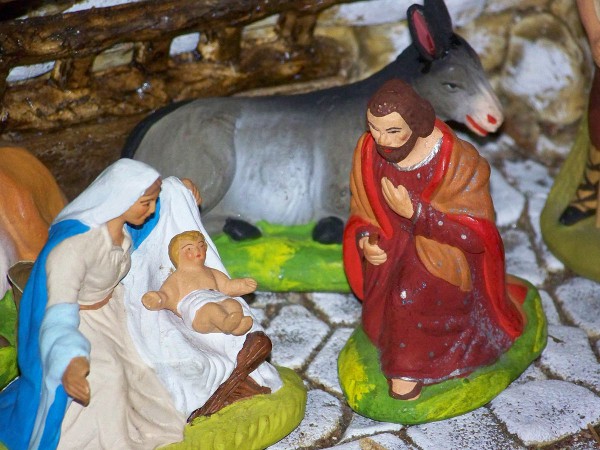
Do you know the santons? These are small clay figurine reprentations, not only of nativity scenes’ familiar character, but also a whole village,, with its inhabitants, buidlings and animals, which serve as background to Christ’s birth.
This tradition exists mainly in Provvence (southern France). The word santon itself comes from the provencal word santoun (”little saint”).
The Origins
Santons first appeared at the end of the 18th century. The French Revolution led to a violent de-christianization campaign. As churches were closed, religious practice took place in private. Miniature nativities designed for display at home replaced those found in churches. Their first materials, papier mâché or bread, were replaced with clay in the early 19th century. French santonnier (santon maker) Jean-Louis Lagniel turned to clay and worked from moulds, which made large-scale production possible.
Characters from Provence’s ealy-19th century daily life soon joined the Nativity story familiar characters. Their clothes are those from King Louis-Philippe’s period (1830 to 1848). They have their own name and story, which is told through ”pastorales” (Nativity plays in French or the Provencal language).
TOP
The making of a santon
Santons are handmade, using burnt clay. This material replaced unbaked clay, which is more fragile, in the early 20th century.
First, the santonnier makes a clay mold, which is placed in two parts in a plaster mold. Each half is pressed in that mold, then both are pressed together by hand.
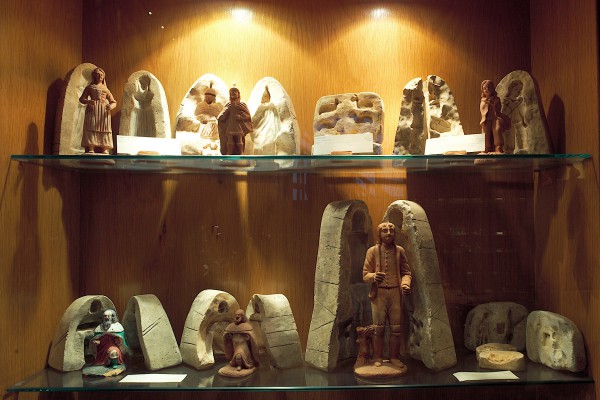
The santonnier then takes the santon from its plaster mold, and removes blemishes and residues The santon is dryed in open air, then oven-baked at high temperature. Finally, the santonnier applies paint.
The Characters
As in any nativity scene, we first have the Nativity story’s main players : l’Enfant Jèsu, Saint Jousé (Saint Joseph), la Santo Vierge (the Virgin Mary), lou biou et l’ase (the ox and the donkey), il pastre (the shepherds) and their sheep, the Wise Men, and Boufarèu, the angel whose trumpet announces Jesus’ birth.
Other key characters in santons and pastorales are :
L’avugle esoun fieu : A blind man and his son, who have come to to ask for the retun of a son who was taken away years earlier
Lou boumian et la boumiane :A nomadic couple, who return the blind man’s son and renounce a life of crime after visiting the barn
Lou Pistachié :A farm hand, lazy and a bit naive, not good at hunting (until he kills a hare on his way to see the newborn Jesus). He brings a food basket. In some pastorales, he is married to Honorine, the fishmonger
Lou Ravi :The ”village idiot”, who marvels and raises his arms when he sees the baby Jesus
Lou viel e la vièio (the old couple)
Monsieur Jourdain and his wife la Margarido, the last persons to hear the angel’s call
Lou conse (lthe mayor), the parish priest, and the firar (Francis of Assisi, who created the first live nativity scene in 1223)
The drummer, who leads a farandole (traditional dance) to the barn
L’Arlésienne (the woman from Arles), on horse, accompanied by a gardian (cattle or horse herdsman)
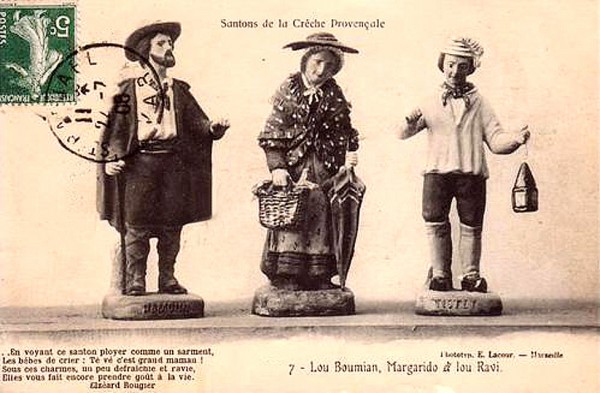
There are also santons for Provence’s traditional 19th-century occupations, animals and buildings.
Through the years,, other characters joined the fray, a result of the evolution of occupations and society as well as the santonniers’ imagination. These include artists, politicians, athletes and other celebrities… and fictional characters. Batman’s Joker and Donald Trump? Mais oui.
The Santon Fairs and Great Collections
Santonniers sell their products in their shops and online, but also through large santon fairs, held from mid-November to early January. The Marseille Fair (site in French) is the oldest, since 1803.
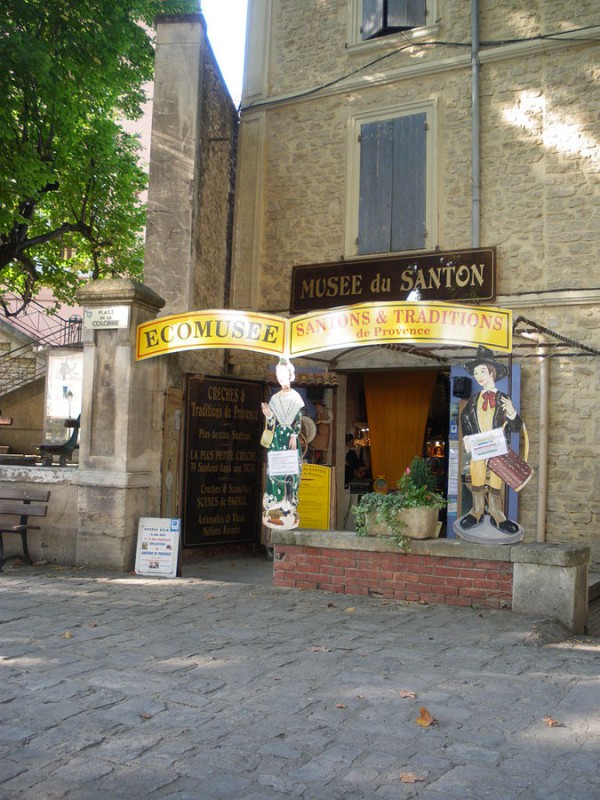
As a key component of Provence’s traditions, the santon is also present in the region’s museums, such as the Écomusée du santon et traditions de Provence, (site in French) in Fontaine-de-Vaucluse, near Avignon. Each year, the old Célestins church in Avignon hosts one of the largest santon nativities in the world (over 50 m2).
The Santons’ Relatives
Provence’s santonniers were inspired by traditions found elsewhere, and they have inspired people around the world.
For example, makers of pressebi napulitani (Neapolitan nativies) included characters taken from daily life as early as the 16th century. In the 18th century, a nativity scene craze gave birth to terracotta figurines, the dressed-up pastori., They competed with, and influenced the santons.
An example of borrowing and adaptation of santonniers’ techniques is the santons de Charlevoix. To learn more, visit, the page dedicated to my collection.